peregrine
Truncated marginal neural ratio estimation for gravitational-wave transients: targeted marginal posteriors at about 2% of the waveform evaluations of standard samplers, including overlapping signals.
I build contrastive learning methods for gravitational-wave science: models that learn what gravitational-wave data mean by learning what belongs together and what does not.
Contrastive learning trains a network to tell matched pairs from mismatched ones. That one principle covers much of what gravitational-wave science needs. Pair data with data, and you learn representations of detector strain that transfer across tasks. Pair data with physical parameters, and you get inference: calibrated posteriors, learned directly from simulations. Next-generation detectors such as LISA and the Einstein Telescope will record far more signals than today’s instruments, many of them long and overlapping, and I develop contrastive methods that scale to that regime.
An encoder learns a representation of detector strain by pulling together different views of the same signal and pushing apart unrelated signals and noise. A good representation captures the physics of the data, so one encoder can serve many tasks.
For inference, the contrastive objective pairs data with physical parameters. This is neural ratio estimation (NRE). Two features make it powerful for gravitational waves. It is marginal: a network can target only the parameters you care about, such as the chirp mass and mass ratio, without sampling the full 15-dimensional posterior. It is targeted: after each round, regions of the prior that are ruled out for the observed signal are truncated, so later simulations concentrate where the posterior actually is. Together these give truncated marginal neural ratio estimation (TMNRE).
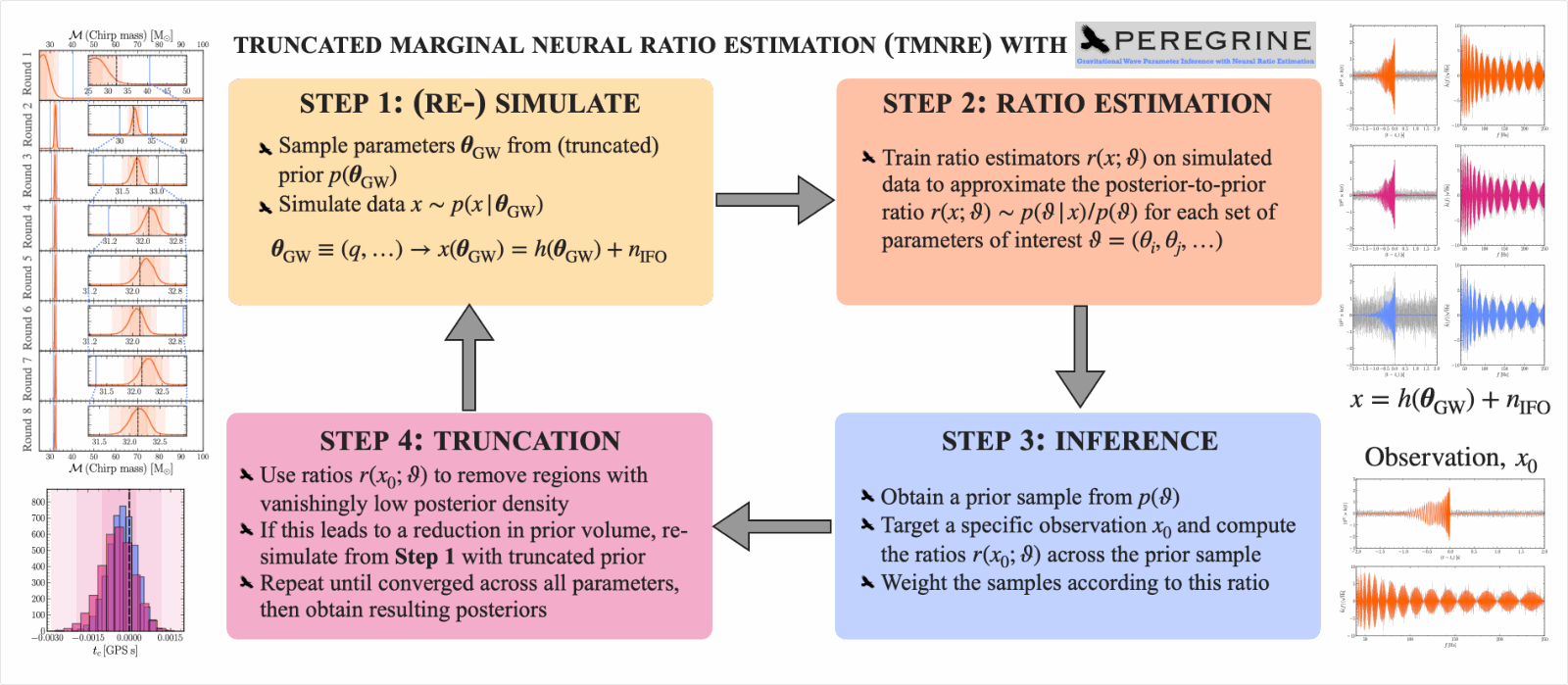
With peregrine we showed that TMNRE recovers marginal posteriors for precessing binary black hole mergers that match a standard nested-sampling analysis, while using only about 2% of the waveform evaluations. Because each marginal is learned directly, cost goes into the parameters of interest rather than the full joint space.
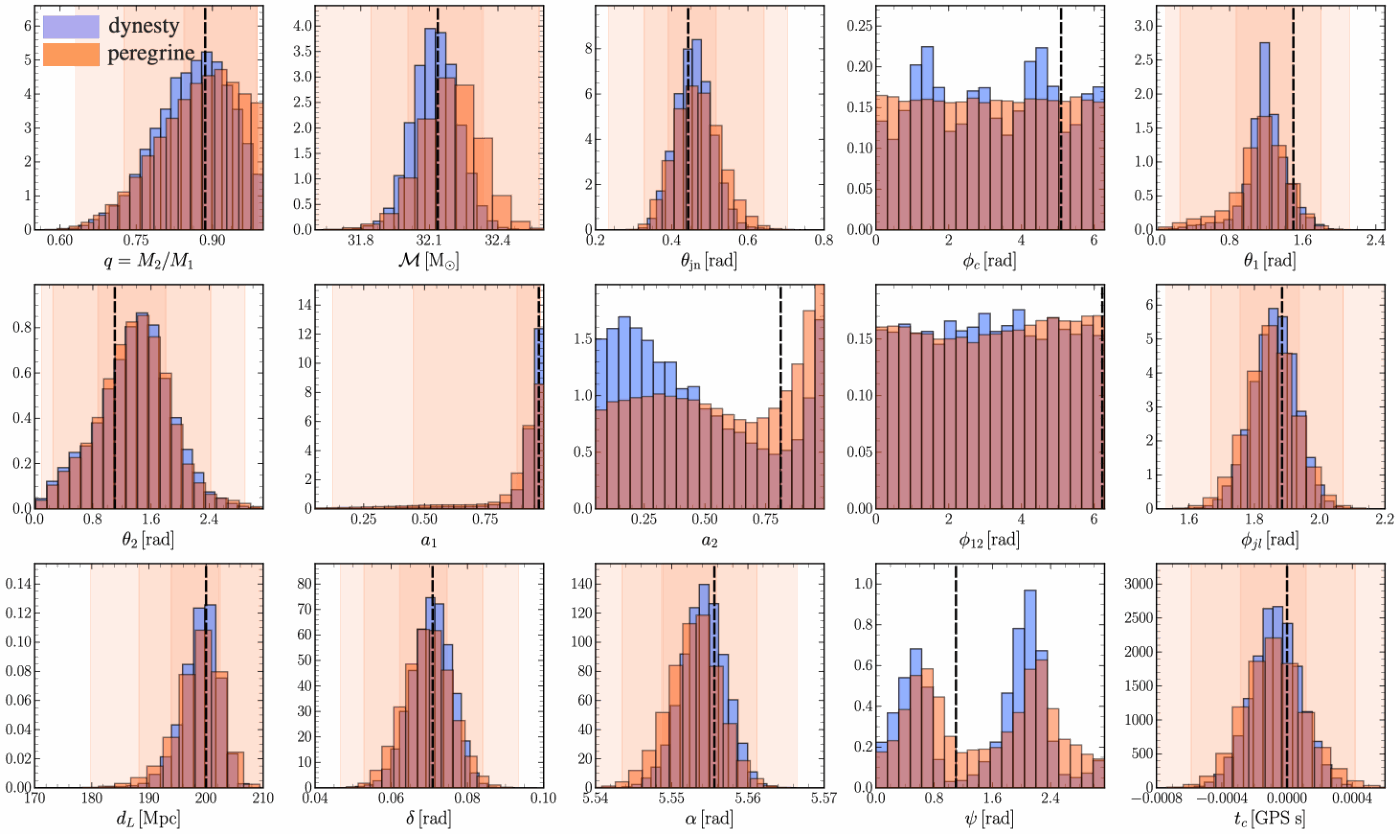
Paper: Bhardwaj et al., PRD 108, 042004 (2023) · Code: peregrine
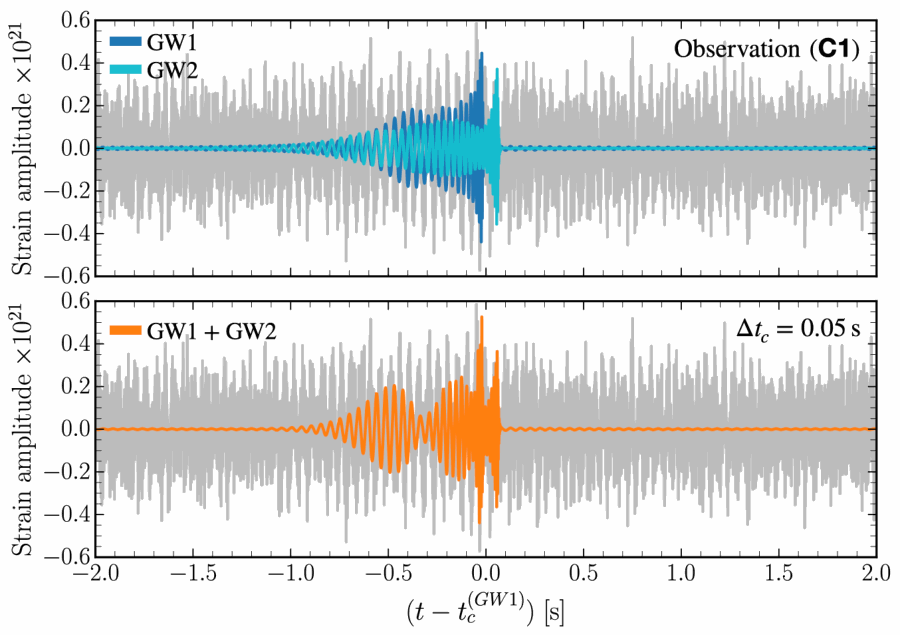
Einstein Telescope and Cosmic Explorer will regularly record several signals in the same stretch of data. A joint likelihood analysis of overlapping sources scales badly with the number of parameters. Marginal NRE sidesteps this: we inferred all 30 parameters of two overlapping binary black holes, using only about 15% of the waveform evaluations a traditional method needs for a single signal.
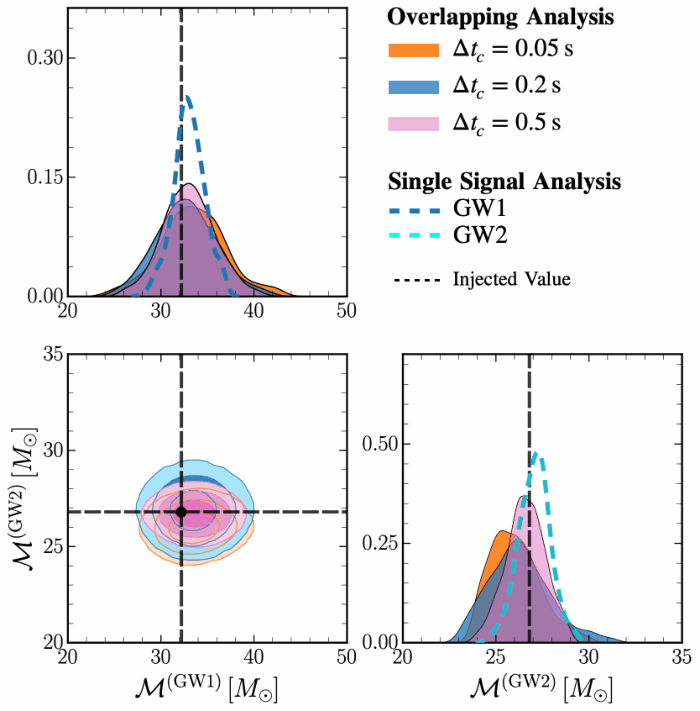
Paper: Bhardwaj & Alvey et al. (2023) · Code: peregrine
LISA data will contain a stochastic gravitational-wave background on top of instrumental noise and a population of transient signals. With saqqara, we use marginalisation to infer the background in simulated LISA data in the presence of overlapping transients. A standard analysis that ignores the transients is biased; the marginal NRE analysis is not.
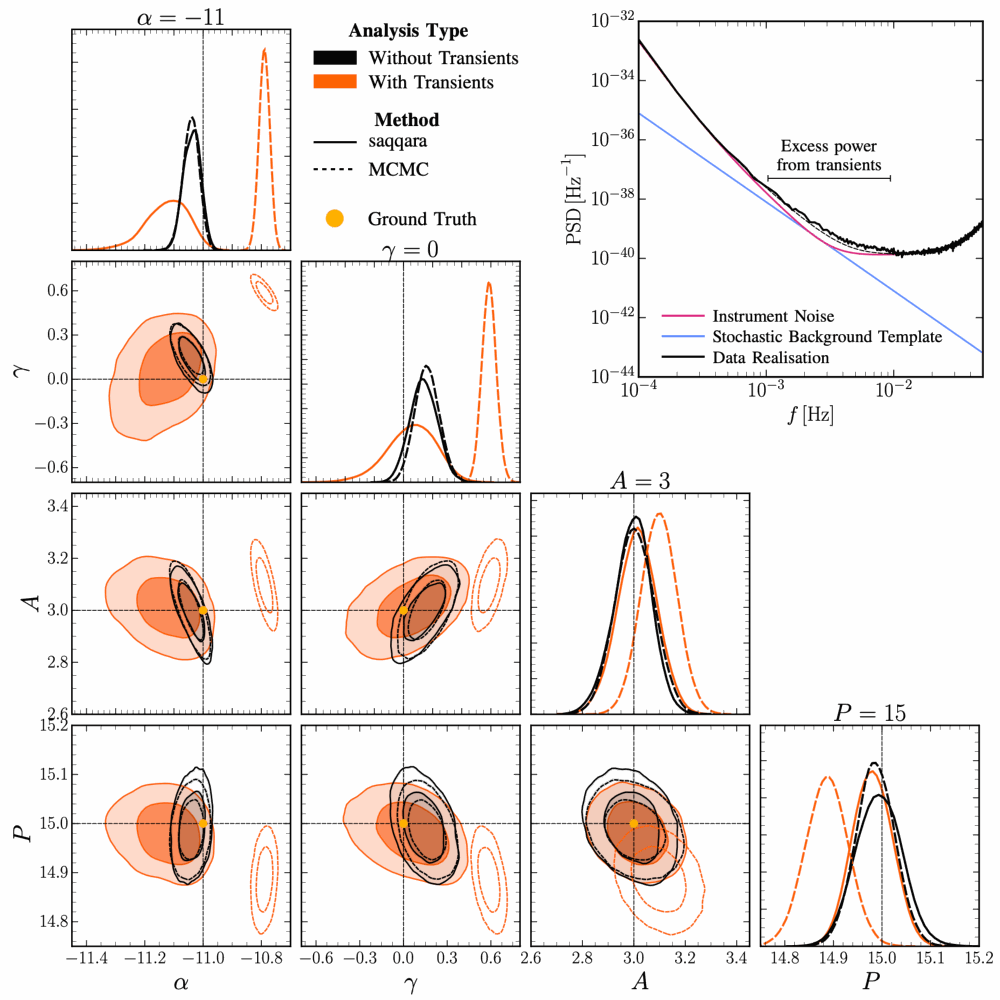
Paper: Alvey, Bhardwaj et al., PRD 109, 083008 (2024) · Code: saqqara
Real LISA noise will drift over the mission. Likelihood-based methods have to model this explicitly, but a neural ratio estimator can learn a data representation that absorbs it. We showed that this representation flexibility turns time-varying noise from a nuisance into an advantage: constraints on the background come close to the Fisher-matrix forecast, and are tighter than when the noise is assumed fixed.
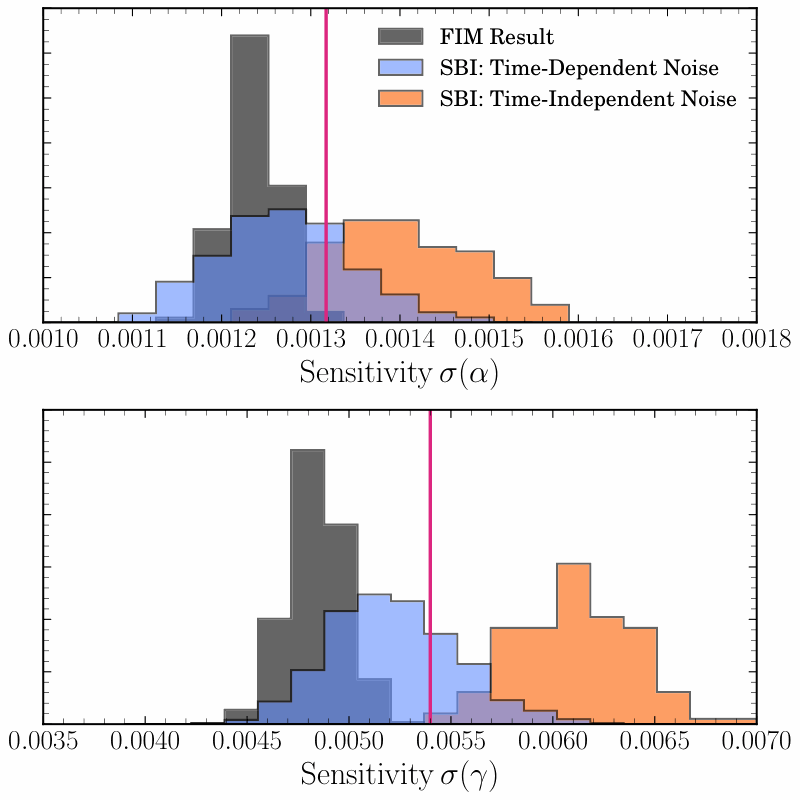
Paper: Alvey, Bhardwaj et al., PRD 111, 102006 (2025)
EMRIs produce long, intricate waveforms with a highly multimodal likelihood, which makes them a hard case for stochastic samplers. Sequential truncation with TMNRE reliably narrows an initially broad prior to the true source parameters over a few rounds.
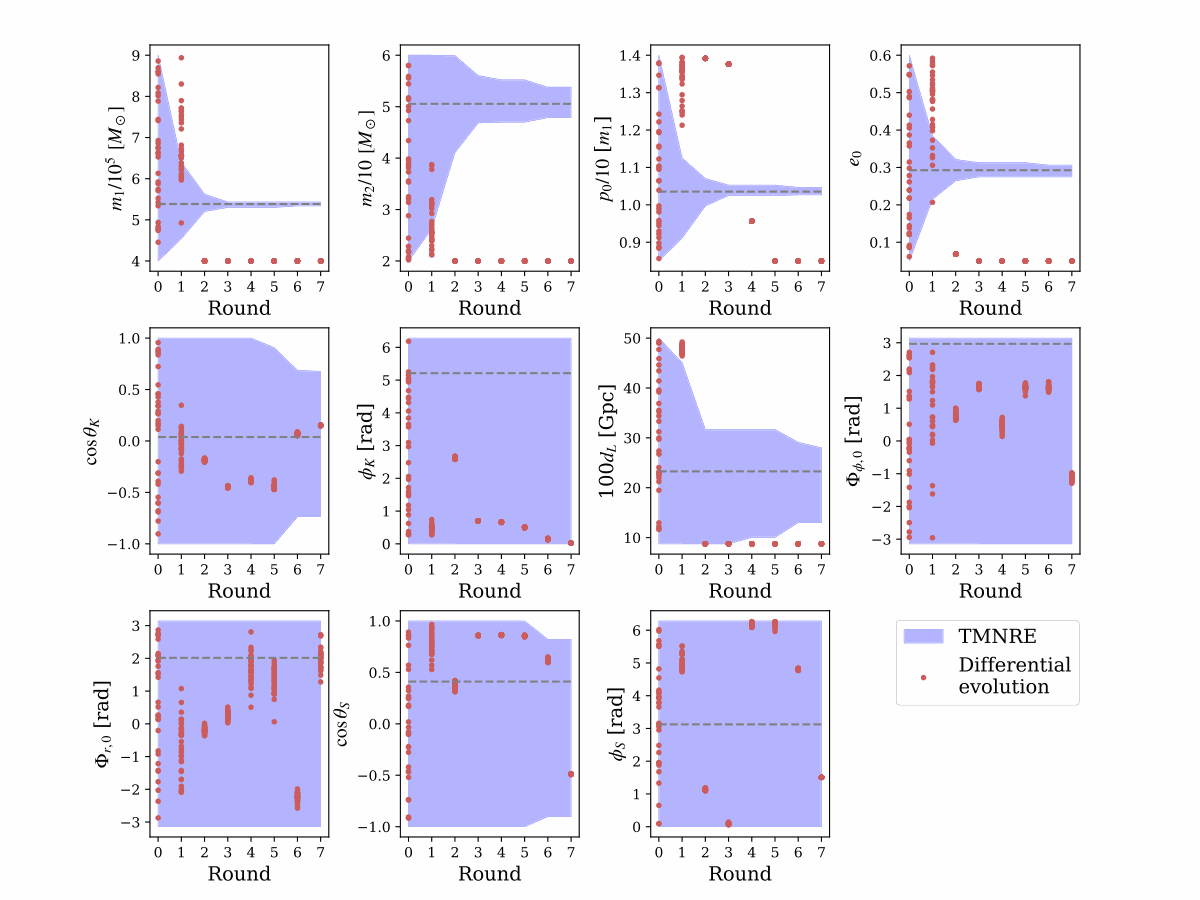
Paper: Cole et al., PRD 113, 063030 (2026)
How binary neutron star ejecta models affect kilonova parameter estimation (Henkel et al. 2025).
praxis configures a large language model as a small research lab that follows the scientific method explicitly; the reference setup and examples use Claude. It frames a falsifiable question, reads the literature, computes on real data, then tries to break its own result, with every number traceable to its source. Domain packs make it an expert co-scientist in a given field; the first cover ground-based gravitational waves and pulsar timing arrays. Built at the Anthropic–ETH AI Sprint.
I supervise BSc and MSc thesis projects in gravitational-wave data analysis and machine learning. I am especially keen to hear from students interested in:
If you are interested, email me with a short, informal motivation statement and your CV.
Truncated marginal neural ratio estimation for gravitational-wave transients: targeted marginal posteriors at about 2% of the waveform evaluations of standard samplers, including overlapping signals.
Neural ratio estimation for the LISA stochastic gravitational-wave background, robust to transient signals and time-varying instrumental noise.
A harness that runs a large language model (examples use Claude) as a small research lab following the scientific method, with provenance-checked domain packs for LVK gravitational waves and pulsar timing arrays.